
‘Women’s sports are delivering:’ A conversation with WTA CEO Portia Archer

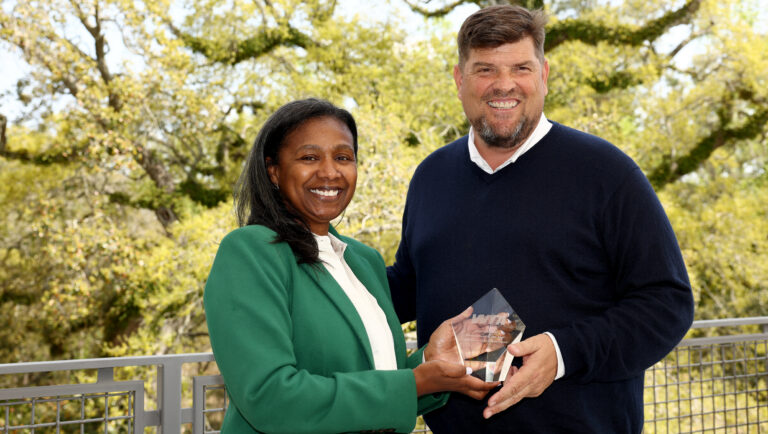
WTA CEO Portia Archer presents Credit One Charleston Open tournament director Bob Moran with the WTA 500 Tournament of the Year award.
After a landmark announcement that the Credit One Charleston Open will provide $2.5 million in total player compensation in 2026, Archer tells Nick McCarvel why the moment means something bigger for women’s tennis – and beyond.
“Women’s sports are delivering.”
The moment is clear for WTA CEO Portia Archer: The future for women’s sports is now. And the long-running trailblazing role that tennis has played in the movement isn’t going anywhere.
“We are continuing to drive forward an agenda that empowers women – and ensures that these athletes have equitable opportunity, compensation and exposure,” Archer tells the Credit One Charleston Open in a recent conversation.
It’s a landmark year for the Charleston Open in that vein: In April, the tournament will offer $2.5 million in total player compensation, which makes it the first WTA event to offer equal prize money – and doubles the 2025 payout.
“It’s huge; it’s incredibly important,” Archer says. “I think this sends an empowering and strong message to the players, to the tour, to fans, and to other potential investors that this sport is strong.
“And women’s sports is strong: It delivers value, and this is a smart, smart strategic investment.”
Archer believes this could be a turning point: Women’s sports, she says, have long been “undervalued… no question.”
“Across every dimension that you can measure, women’s sports – and women’s tennis in particular – is delivering or over-delivering against that measure.”
Those metrics include attendance, social media, fan engagement, partnership investments and more, Archer says, adding: “I think our partners are starting to recognize that.”
It’s the potential of women – of female athletes – that Archer says is finally being invested in.
And it comes long after Billie Jean King and the Original 9 formed the WTA over 50 years ago.
“Women don’t get the benefit of being able to be promoted, if you will, or invested in, based on our potential… so we actually have to deliver,” she says. “We’ve got to do the job before we get promoted to the job. And so now [that] we have the data, it’s a really strong and compelling business case across every measure. And I think our partners are starting to recognize that.”
It makes the move at the Charleston Open that much more pivotal. A year ago, Archer took a few friends to the tournament as a part of her visit to the event. She even threw on a baseball cap and shrugged off her corner office suit.
All in the name of soaking in the true coastal charm of the historic WTA 500 stop.
“My friends aren’t the easiest to please,” she smiles, recalling their trip. “High marks; high marks.”
“I think it’s a unique event,” she adds of the women’s-only stop, the only held on green clay on the WTA Tour.
“I think the players enjoy being there, and I think a lot of that has to do with Bob Moran and his care and attention.”
“The tournament, it has a real soul to it.”
Read more of Archer’s thoughts below. Her answers have been edited for clarity and length.
Nick McCarvel, Credit One Charleston Open: For you as CEO of the WTA, how do you define your role? It’s such a cool moment in women’s sports in general, but for women’s tennis, what responsibility are you feeling right now in your position to help move the sport itself forward?
Portia Archer, WTA CEO: I’ve always felt a bit of a responsibility stepping into this role – and that hasn’t changed at all over the last year and a half or so.
We really do stand on the shoulders of giants, I feel. I mean, our founders, Billie Jean King, who is an icon… I think it’s important and I take the responsibility very seriously to continue to carry on some of the things that Billie Jean stood for and stands for and the things that she had in mind when she started the WTA wi the Original 9.
For me, it’s really about capitalizing on this opportunity and really leveraging the movement and this moment that we’re seeing across women’s sports for the benefit of of WTA athletes. And part of that includes in my role making sure that we have a really strong organization for today and for the future that can scale across the now 100 plus events that we – between the Tour events and our 125 events – provide opportunities for players to play and compete, to earn a living, and to also be recognized for their talents and achievements on the court – and not just for things off the court, like what they’re wearing or what they look like.
Those were three of the things that Billie has always said that she started the WTA for, to provide access to girls to play… for those who were good enough to be able to earn a living, and then for girls to be recognized for their talent. So I think it’s incumbent upon me in this role to make sure that we can continue to build the organization that can carry that through.
Nick McCarvel: We’re just seeing so much energy across women’s sports and the WTA, I think, is a pioneer in that. So what’s the challenge as you see all these other women’s sport have this attention and energy?
Portia Archer: It is both a challenge and an opportunity. I think that’s right.
The WTA, we had four million fans come through turnstiles at our events across the world. That’s up about 500,000 over last year when we were at 3.5 million. If you look at social media growth, the WTA is the fastest-growing social media platform in women’s sports, I think we were up nearly 30 percent last season. So whether you think about fan engagement, whether you’re thinking about attendance, or investments, partnerships… media, broadcast and sponsorships, the valuation for WTA events… were higher than ever. Across every measure.
It’s exciting; I’m excited about our partnership roster. The Mercedes-Benz partnership is historic and it’s one that we should laud. I [also] don’t want to leave out partners like Credit One Bank, who have invested mightily in women’s tennis. [With the Charleston Open] doubling prize money and offering 2.5 million… it is also exciting and it is also historic that Credit One Bank is investing ahead of schedule, voluntarily in compensation through prize money at the Charleston Open.
From this year and moving forward, I think you’re seeing that across women’s sports. So, we’re looking forward to continuing the push and really do commend our partners.
We’re in a good spot and I’m excited about the opportunities ahead. But we do face some challenges in getting there.
Nick McCarvel: I think the roadmap is 2033 for the WTA and equal prize money [with the ATP Tour]. How exciting is it then… in terms of longevity and this being a tent pole moment? And what’s been the conversation among the players and other folks around the WTA that Charleston has made this move?
Portia Archer: The reception from the players has been phenomenal. Venus Williams, another giant who’s been a champion for equal prize money for some time, she’s talked about the progress that it shows, the belief in women’s sports that it’s shows. It sends a strong message to the current player community.
The reception has been great; it’s welcome. Our players love playing at Charleston; it is such a wonderful event. … For a tournament with this kind of history, with this kind of legacy and reputation to do something like this voluntarily ahead of schedule, I think it’s really meaningful.
The players can express their concerns about many things, [but] there’s been nothing but a positive reaction from the player community. It’s quite unique that you can get consensus across the players – and this is nothing but good.











Related Articles