
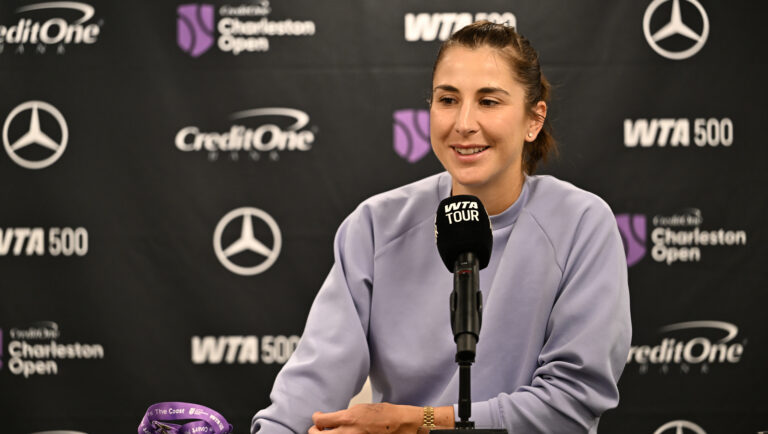
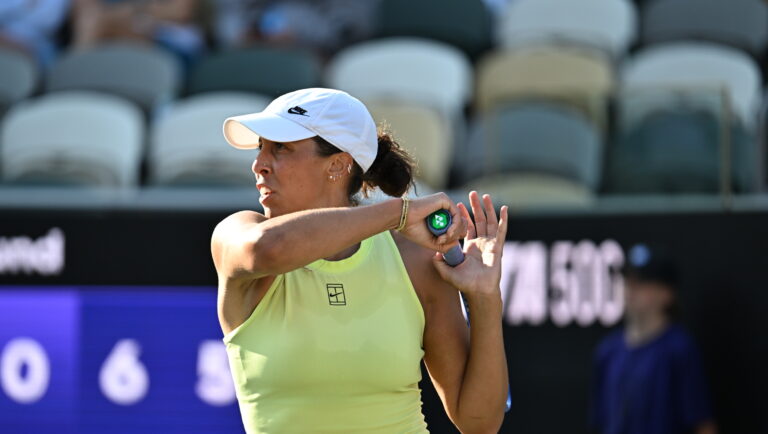
Transcript: Pegula def. Putintseva 4-6, 6-4, 7-5 (Second Round)

(c)2026 Chris Smith 843-324-8900
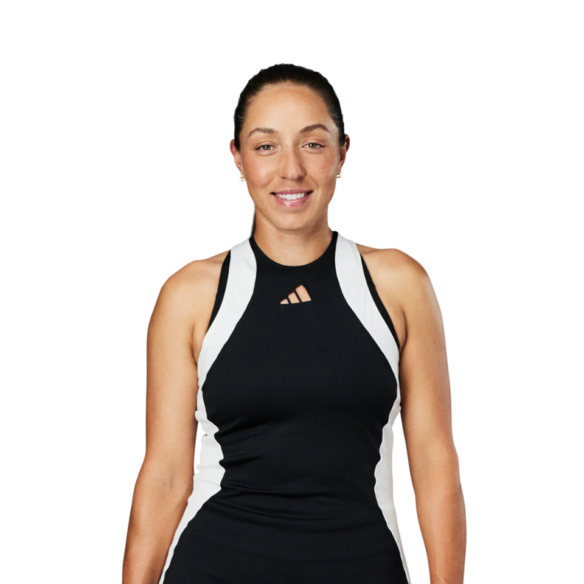
Jessica Pegula def. Yulia Putintseva
4-6, 6-4, 7-5
Round of 32
An Interview With
Jessica Pegula
THE MODERATOR: Jesse, congratulations. Just your thoughts on your win.
JESSICA PEGULA: Yeah. That was a really crazy match, three-hour match. All I kept thinking was like, we’re into clay court season, like this is really quite the introduction.
I knew it was going to be really tough against Yulia. I think she’s somewhat of a clay courter, especially with the way she was playing today. I didn’t feel like she missed many balls, was not giving me any free points. I had to win every single point.
So just a really tough, really tough test for me today.
THE MODERATOR: Questions?
Q. Great win out there today. You’ve had a lot of, as in your words, like crazy type of matches in Charleston, not only this one in Yulia, but you last year that was really epic and even a couple from 2023 and 2024. This is kind of a three-part question.
Are you aware of this trend of you playing these type of matches in Charleston? That’s the first one.
Second, why do you think you have these sorts of matches here?
Third, what role does the crowd play in helping you get through some of these matches?
JESSICA PEGULA: Yeah. Today I was kind of thinking of it during the match. It was, like, why do I always have these matches. Like against Danielle last year I was down like a set and 2-0, and then the Alexandrova match, and then I remember the Azarenka match from a couple years ago, and like all these matches started going through my head, and I was just like, why, why, why. I don’t know what it is.
I mean I, do think it’s hard because it’s the first week on clay. So I think everyone is trying to get used to moving again and playing points a little bit differently and constructing points differently. I do think that points can be longer. The balls seem kind of heavy here when the clay gets wet. Like it’s tough to hold serve because it doesn’t really move.
Like coming from Miami, even Indian Wells, you’re getting a lot of free points on your serves, and then all of a sudden you’re not. So it’s just longer games.
It’s just clay court tennis, and I think it’s a little bit of adjustment for everybody to kind of be in those positions and playing points and matches.
So I don’t know if that has something to do with it. I think for me it does a little bit. It’s just like sometimes you remember how to play on clay and then sometimes you don’t. It’s kind of coming in and out of the matches.
But I couldn’t tell you why exactly I seem to have wild matches here. But it is very true.
And I think the crowd definitely really helps me. I always want to play well here. I think they’re always carrying me through matches. I always want to make sure that, even if I lose, that I’m competing the whole time, because they come out to watch me play. I have a lot of friends and family that come out and watch me play here.
And especially this year, I think it was one of the matches where I could have just tapped out and probably been like, you know what, I’m having a great year; it’s my first match on clay. Yulia is playing great. Like I could probably just mail this in and like — but I really didn’t, obviously, did not want to do that. I wanted to power through and hopefully use this win as a good setup for my clay court swing long-term. And the crowd really helps me with that.
Q. Jessie, you’ve never lost to her, but I could imagine just from the look of it, she’s gotta be a pain in the neck to play, in general.
JESSICA PEGULA: She’s a nightmare. Like, if there’s one person in the draw I would really not want to play first match on clay, she was like the number one, probably, person in the draw. And she’s really tricky, especially — I don’t think we’ve played on clay before. So I knew it was going to be harder for me.
I think it suits her game a little bit better on clay. So I hadn’t played her on clay before. I knew it was going to be harder, and I knew I was going to have to do some stuff that was different than maybe on a faster hard court, which can be really tricky.
And, again, just being the first match, like not used to the footing and the moving and setting up the points differently. It doesn’t feel like that much of a difference because I’m still trying to do the same things, but against someone like her where I felt like she was playing at a really high level, I was having to execute a lot of clay court tennis stuff that I haven’t done in a year.
So all of a sudden everything changes, and only having a couple of practice days under my belt, it was definitely a very hard test for me, but, yeah, she played, I think, great. I mean, she was, yeah, making me earn it.
Q. Just in case you’re wondering, it’s still Wednesday. Talk to me about the last few games how much of that was mental.
JESSICA PEGULA: Yeah. It was definitely a ton mental. I felt like I was tight serving it out at 5-3. It was on the tougher side against the wind in that shadow, and I was like, gosh, this is going to be a tough game. I think I tried to be too cute and hit a couple of drop shots. That probably wasn’t a good idea. I was definitely a little bit tired, but I just did a good job of, even though I lost serve, I wasn’t that upset. I mean, we were going back and forth the whole match, so I didn’t think I needed to get insanely upset that I didn’t serve it out at 5-4.
So that was kind of my mindset. Didn’t play a great game, wanted to go back to more of like the basics of what I did to get up to 5-3, and, yeah, luckily was able to get out of it there and serve for it again.
Yeah, it was just tough. I was really tired. I mean even the last — when I broke her, I think, and she missed that kind of sitter, I was just scrambling, like just hoping she would miss at that point. It was definitely — it was strategy, but I think the last couple of games it was definitely just competing and trying not to get frustrated, trust myself and stick to patterns.
Q. Back to the personality.
JESSICA PEGULA: Yeah. Just digging out when I could and not letting too many things bother me.
Q. Jessie, you kind of keep talking about this, but start of your clay season. There’s only been like, I think, fewer than five years you haven’t played this tournament. I guess how big of a deal is this tournament as a transition? Like the years you haven’t played do you really feel when you get to Europe and you’re like, oh, my God, like how important is that kind of that like halfway point for you on clay?
JESSICA PEGULA: Yeah. I don’t really remember what happened in the years I didn’t play.
Q. It was like ’14, ’17.
JESSICA PEGULA: Really?
Q. You’re pretty consistent here.
JESSICA PEGULA: Yeah. I don’t even remember what happened those years of why I didn’t play. But I think it’s a great transition because I think it gets my feet under me, but then at the same time, like, I’m not playing till Madrid. So then I can go home and do some stuff that like, okay, what did you do while in Charleston and what needs to get better and kind of work on those things.
And I already have competed on clay now, and again tomorrow. And last year was the same. Like I saw myself compete on clay. I think it can give you a little bit of confidence, but then I think just sets up a baseline of, like, okay, here’s where you are. Now let’s see how we can improve this for the rest of the clay court swing where it’s a little bit of a different surface as well. So it’s not exactly like comparing apples to apples. I think it kind of sets you up for what you need to work on, which I really kind of enjoy that.
Q. This might be a really dumb question. When you go back home, you only practice on clay?
JESSICA PEGULA: Uh-huh.
Q. You’re not back on hard?
JESSICA PEGULA: No.
Q. Can you explain a little bit more about the differences between the green and the red? What are those little things you’re talking about?
JESSICA PEGULA: Just a different surface. I mean the green is more of like these little pebbles that you can kick out of your clothes, whereas, the red clay is more of a chalk. So it’s a little bit different, I think, moving on, and then maybe not as slippery maybe, although it depends because Madrid can be a little slick because it plays faster in altitude and stuff like that.
So, I mean, it honestly varies from everywhere that you play, but I would say maybe not as slippery. I think the green clay here can tend to play pretty fast. And it’s just in general, it’s just a different surface. Yeah.
Q. So just going off the length of the match, this was your longest win in your career.
JESSICA PEGULA: Really?
Q. Yes. Congratulations.
JESSICA PEGULA: Thank you.
Q. Going off of that, I guess how are you feeling physically, and do you think you could feel the effects of a three-hour match it being your first match going into the rest of the tournament?
JESSICA PEGULA: Yeah. Actually, I was really thinking about it, and I’m actually kind of glad. Like even though it’s not ideal maybe for tomorrow, but I do feel like getting a three-hour match, like, I mean, you really break in the lungs. Like the aerobic and anaerobic fitness gets broken in quite a bit. And I feel like that actually, if I can get through tomorrow, I think can set me up more further down the line. I’m not sure if it’s the best thing for tomorrow, but I mean, like, it is what it is.
But I think in the long-term, actually, it’s a great way, because I remember playing the French last year, and I had a couple of really long matches on clay, and I honestly felt kind of like I was out of shape in a way because I hadn’t had a really long, physical match like that. And I don’t ever want to feel like that in a Slam.
Like you kind of want that to happen before that so then when you do get to that point, if it’s a long match, you feel fine. So I actually was looking at it in the way of, like, I hope it sets me up for further down this week and then into the clay court season.
Q. Jessie, some of the players this week have been making use of the new Yonex Mindset and Performance Program, and obviously you have your own team, but as a Yonex player, I imagine you have access to those resources. Have you been briefed on that and what do you make of that?
JESSICA PEGULA: I haven’t. I know nothing about it. I’m so sorry. Yeah, I hope Yonex doesn’t get mad at me, but I haven’t talked to them about that at all. So I, frankly, have no idea.
Q. You haven’t heard about it?
JESSICA PEGULA: I’ve heard about it, and I know that Pam was part of it, but I have no idea what it is. Sorry.
Q. Jessie, you talked about you’ve come to Charleston so much. I wanted to ask sort of what makes this tournament so special that you would want to come back? You have options of other clay tournaments that you could have gone to, but you chose to come here.
And then, also, the tournament sort of put up the money to make this on par with other ATP tournaments in the way of making it almost equal pay at the 500 level. What are your thoughts on that, and do you think other tournaments should sort of like emulate that?
JESSICA PEGULA: Well, first of all, I love playing in Charleston. I learned how to play tennis in Hilton Head, which is only a couple hours away. And so to me it feels very familiar. I lived here for a couple years as well and trained here in my early 20s. So I’m just very familiar, and it’s easy. It’s nice.
It’s, I think, an amazing tournament, probably the best, if not one of the best, tournaments we have on tour. And I think that’s why I always come back, because it’s really — it’s a fun week for me.
Like I come up, my husband comes with me. We bring our dogs with us. I see a lot of friends. We see a lot of family, and I just feel like it’s nice to be able to play a tournament where it doesn’t feel so high stressed all the time.
It’s easy to enjoy the city. It’s easy to kind of have — you’re still trying to win matches, but it’s a little bit of a lighter week, and I think that the tournament always makes you feel super welcome and wants you to enjoy being here in Charleston, with the fans, with the people, with the food, with the experiences. And it’s nice to have that and to just not be tennis constantly, which I think is refreshing to have on tour, and sometimes we need weeks like that. So it’s always really fun for me to play here and why I’ve played it so much.
And on the prize money piece, yeah, when he announced it last year after the tournament ended, I just thought it was amazing. You know, sometimes you need someone to kind of step up and set the standard and set the bar for others to follow, and I think that’s what he’s done, and I think in turn that you will see probably some 500s maybe on that path, maybe not right away, but maybe sooner than they had planned because now all of a sudden the standard is set higher, and I think it creates a really nice healthy competition amongst the tournaments. I think it holds them accountable, and I think it also puts the spotlight on, even though we are equal at the Grand Slams, it’s definitely not equal at all the rest of the tournaments. And I think sometimes fans don’t actually know that.
So I think it kind of just puts a spotlight, again, on women’s sports, and it’s growing, and Ben being able to put the money behind that and showcase that he wants to stand up for our sport and pay us what he thinks we deserve, and I think to set that standard for the rest of the tour to hopefully one day follow.
End of Interview
Players in this article